Sweeney Quote

Indie Reader Review of “The American Sweeney Todd”
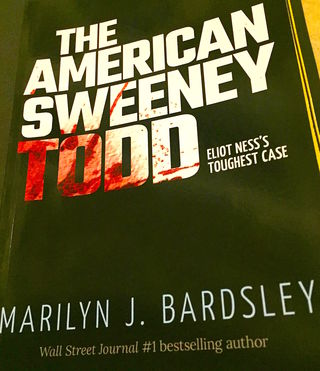
THE AMERICAN SWEENEY TODD
Verdict: True-crime aficionados will be delighted by THE AMERICAN SWEENEY TODD, a disturbing, intimate look through the eyes of one of America’s cleverest and most dangerous serial killers.
5.0
A brilliant but troubled surgeon becomes a serial killer – but can he evade the famous Elliot Ness?
Dr. Frank Sweeney had a troubled childhood. raised in poverty with an alcoholic and abusive father. A bright and hardworking young man, he served in the Army in World War I and afterwards worked his way through medical school, building a successful career as a doctor. But his inner demons came back to plague him in the form of alcoholism and drug addiction, and his marriage and career paid the price. His broken mind turned to murder as a means of finding release and power, and he began to kill and decapitate anonymous victims, becoming known as the Mad Butcher. But Elliott Ness, fresh from his campaign against Al Capone, had come to Cleveland to reform its police department, and he was hot on the Butcher’s trail. Could he bring down Sweeney’s violent career?
THE AMERICAN SWEENEY TODD is a short book, which is partly regrettable and partly a blessing. It is regrettable, as it is extremely well-written and powerful. It is a blessing in that once you pick up this book, it is very difficult to put it down until it is finished, and it is haunting. The well-advised reader will set aside an hour or two of uninterrupted time for this book, will read this book in broad daylight, not before bed, and ideally will have a hot shower and something comforting and ordinary to do afterwards.
The book is presented from Frank Sweeney’s first-person perspective, and it brilliantly draws the reader, directly and believably, into his viewpoint: his arrogant contempt for others, his bubbling anger at the world, his violent urges – and also his struggles to free himself of his demons and find a better, healthier life for himself and his loved ones, especially his sister. He is not presented unilaterally as a demon nor a monster – just a man, even seemingly ordinary enough at times, until his brokenness and anger come into vivid view again, all the more disturbing for the contrast. The murders are described with chilling straightforwardness, with just enough detail to convey their true psychopathic horror, right alongside journal entries describing affectionate visits to his beloved sister, or subtly taunting evenings spent having drinks at a police bar with the very officers investigating his case. The story is at once enthralling and horrifying, heartbreaking and spine-chilling.
True-crime aficionados will be delighted by THE AMERICAN SWEENEY TODD, a disturbing, intimate look through the eyes of one of America’s cleverest and most dangerous serial killers.
~Catherine Langrehr for IndieReader
The G-Man and the Serial Killer
Psychology Today
The G-Man and the Serial Killer

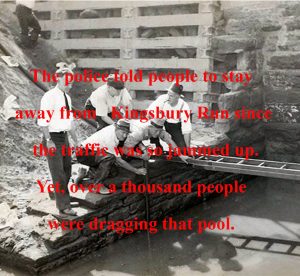
In September 1934, part of woman’s torso, with legs severed at the knees, washed up on the shore of Lake Erie in Cleveland, Ohio. Never identified, she became known as the Lady of the Lake. A year later in the slums of Kingsbury Run, two headless, mutilated male corpses were found with genitals removed. In 1936, the remains of a prostitute turned up in a basket behind a butcher shop just before another male was decapitated and dumped. The killer acquired a moniker, “The Mad Butcher of Kingsbury Run.”
Cleveland’s Director of Safety was the famed Eliot Ness, former G-Man and founder of “the Untouchables.” Stymied over his inability to nab the local serial offender, he ran raids and ordered a slum to be burned. This served no purpose. There were more bodies. After analysis with a team of professionals, Ness narrowed his focus to a surprisingly educated suspect, a mentally unbalanced alcoholic from a prominent family. Ness was playing a risky game.
So was writer Marilyn Bardsley, who heard spooky tales about these incidents as a child living in Cleveland and who doggedly pursued it as an adult to learn the secret that Ness had kept for almost forty years: the suspect’s identity. She thought about writing a play. This got her a phone call from a psychiatrist who claimed to have witnessed the meetings between Ness and the suspect. He said that if she discovered the man’s identity, he would tell her more.
Now she had a challenge! As she made headway, her only manuscript was stolen. (No storage drives back then.) She carried on and discovered she was being followed. When she was warned off the story, she gained some clues. More people popped up who had something to say. This clearly was a dangerous secret! But she figured it out. Bardsley meant to collect what she had gathered into a nonfiction book, but this didn’t happen. Now she has written it as a novel. Thus, it feels more alive.

The American Sweeney Todd is a fictionalized account, based on actual documents and interviews, narrated via the killer’s journals. Since Bardsley has written extensively about many different serial killers, her background provides authentic dimension.
It’s not easy to put yourself in this nasty man’s mind as he describes what he does to people and why, but some of his ramblings remind me of my own 5-year project with Dennis Rader, the BTK serial killer from Wichita, Kansas. Rader had appreciated Jack the Ripper because he never got caught, inspiring endless fascination to this day. So does this guy. When Rader went unidentified for thirty years, he formed a plan to inform people after his death that he was the infamous BTK killer. So does this guy.
Like Rader, the Mad Butcher scans the newspaper for mention of his “work.” He hates being ignored. Reacting to one article, he says, “Not only have I made the front page again, but I have taken it over. At last, I am somebody in this city.” Rader, too, loved terrorizing his hometown. He complained about his lack of media attention.
However, BTK named himself to ensure that no one picked a moniker he disliked; the Mad Butcher didn’t realize this could happen. He was no butcher at all, but a trained surgeon. Still, the butcher notions kept attention off him. At first.
So, readers are taken through each of a dozen murders from the killer’s perspective, as he gives his various justifications. He’s believable, with his personal demons, his life distractions, his awareness of the investigation, his elitism, and his functional psychopathic lunacy. It’s all based on interviews with former detectives, associates of Ness, and people who once knew the deranged doc.
Just as interesting is Bardsley’s account at the end this book of her pursuit of “Eliot Ness’s toughest case.” I’ve known her since my days of writing for Court TV’s Crime Library, which she founded and managed. We’ve had a few adventures together. She doesn’t scare easy, so those people who warned her off the story didn’t know who they were dealing with. To her credit, the warnings only alerted her to the importance of getting this story right and putting it out here for the rest of us. I’ve heard her tell it before, so I’m glad she has finally found a format for it.
Ness kept his suspect imprisoned in a hotel, taking polygraphs and being forced into a deal that would benefit all and avoid embarrassing certain officials. For me, this encounter is the best part. In 1938, the doctor agreed to Ness’s ultimatum, disappeared from the public eye, and the murders stopped.
Whether the Mad Butcher had also killed people in Pennsylvania is the subject of another book, written by a Bardsley’s colleague, James Badal. I reviewed Hell’s Wasteland here. Both books are worth a read, especially together. The creepiness factor is prominent, but so is the painstaking work to take readers back to a past time when a vicious serial killer in town was truly terrifying. For both of these reasons, this novel is a page-turner.
References
Bardsley, M. (2017). The American Sweeney Todd. Crimescape.
Crimes that Stain Your Soul: What you Need to Know About the Christopher Barrios Case
The Christopher Barrios Case

Crimes That Stain Your Soul: A History of the Case
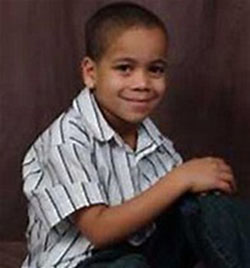
In March of 2007, my photographer husband I covered the Crime Library breaking news of a six-year-old boy missing from his neighborhood. We lived in Savannah, a little over an hour drive down I-95.
Christopher was last seen skipping toward his home, with a toy “light saber” in his hand, but he never reached home. When his stepmother realized Christopher was not at his grandmother’s and couldn’t locate him, she contacted his father at work to help with the search. They couldn’t find Christopher and called the police.
Local investigators and Georgia Bureau of Investigation quickly organized search teams and interviewed the residents of the mobile home park. One of the investigators saw a “lightsaber” in the yard of a mobile home that was in the path that Christopher took to go from his grandmother’s home to his father’s. The investigator observed that the occupants behaved suspiciously when he asked about the toy. The trailer park housed a number of men with a history of sex offenses, including Christopher’s father.
The Perpetrator
This case is an example how a state’s best intentions can go horribly wrong. In 2006 Georgia strengthened its laws to prevent child molesters from exploiting children on playgrounds. Specifically, child molesters were not allowed to live within a thousand feet of schools and playgrounds. The Superior Court in Brunswick, GA convicted George Edenfield in 1997 for molesting two young boys. The parents refused a deal of a trial and moved away. George was sentenced to ten years probation because it would have been difficult to sentence him to prison without the boys as witnesses.
During that decade George Edenfield lived with his parents downtown on Union Street. The house was several hundred feet from a playground, which was in clear violation of the new Georgia law. Glynn County authorities told George at the end of August that he had to leave. His failure to do so caused his arrest in September 2006. A month later the Edenfields moved to the Canal Mobile Home Park on Horseshoe Lane where children of various ages lived. Among them was a six-year-old boy named Christopher Barrios.
While the 2006 Georgia law prevented sex offenders from living near a playground, there were no restrictions barring child molesters from living near school bus stops. There was a school bus stop very close to the mobile home park where the Edenfields had moved.
The Charges
On Monday, March 5, 2007, George, faced Glynn County Superior Court Judge Stephen Scarlett on the charges of having lived too close to a playground. He pleaded guilty, and the judge sentenced hem to ten additional years of probation. A local official familiar with George Edenfield’s case asked for a stricter form of probation, but a state official persuaded the court that it was unnecessary. Apparently, during the ten years of George’s probation since 1997, no one had come forward with a criminal complaint against him.
Three days later on Thursday, March 8 shortly after 6:30 p.m. Christopher Barrios was missing. Christopher lived with his father and stepmother in the mobile home park, and his grandmother lived in the same park. The Edenfields lived across the street from the grandmother. The path Christopher Barrios took to go from his grandmother’s residence to his fathers’ went past the Edenfield’s trailer.
Finding Christopher
The following week investigators found Christopher’s body in trash bags in a wooded area. The boy had been raped anally and orally and choked to death.
One sex offender stood out as a prime suspect: George Edenfield. George’s father, David Edenfield, was also an offender who had sexually assaulted a member of his family. The elder Edenfield admitted that he and George had lured Christopher into their home. The two men raped and sodomized the boy while Peggy Edenfield watched and masturbated. The Edenfields believed that after the horrific sexual assault, their only chance of avoiding detection was to kill the child and dispose of his body. David Edenfield told authorities that as his son strangled Christopher, he put his hands over George’s so that he could feel what it was like to participate in a killing.
“Christopher was dead. I guess it excited all of us,” David Edenfield said.
David, Peggy & George Endenfield Mug Shots
He persuaded his friend Donald Dale to help conceal the crime by wrapping him in plastic trash bags and lying to the police.
While we were in Brunswick, we decided to learn a bit more about George Edenfield, so we walked around the neighborhood he had lived in for so many years and took photos of the house and the playground that was instrumental in his move to the mobile home park. We also stopped people on the street and knocked on the doors of homes around the one in which he had lived. Most of the people we spoke to either didn’t know him or knew him but didn’t want to talk about him.
The Interviews
Finally, one woman reluctantly gave me an interview about what kind of person George was. From her perspective, there was something wrong with him. She didn’t know whether he was mentally ill, developmentally challenged, autistic or a combination of those conditions. His behavior was abusive and frightening. She was terrified of him. She wouldn’t even drive her car past his house after the threats he had made to her. One day when she was in her front yard, he came over to her with hedge clippers in his hands and a look of sheer hatred in his eyes.
“I’m gonna cut your bush,” he said as he opened and shut the clippers close to her abdomen. She backed away from him quickly, got into her house, and locked the door. It wasn’t the first time that he harassed her, banging on the door with his fists and yelling obscenities.
Later that day, we went to the mobile home park to talk to the residents and take photos. involvement in Christopher’s death. The people that lived there fell into two different camps when asked about George Edenfield. They all knew that there was something permanently wrong with him given his inexplicable bursts of anger and rude behavior. Some of the residents felt sorry for him and his parents, but others were afraid of having him live with them.
His parents had told the neighbors that George was fine when he took his medicine and that he was harmless. We also learned that George had stalked and propositioned two teenage boys and waited for them at the bus stop frequently in the afternoons when they came home from school. They did not know he was a convicted child molester.
The mother of one of the teenage boys George had propositioned granted me an interview. She told me that when her husband found out, he was going to kill George. The caretaker of the trailer park and the boy’s mother had talked the husband out of taking any action. The family had experienced some trouble with the authorities in another state and did not want it known to the park owner.
I spoke on the phone to the father of the other teenager George had stalked. When the father first heard of it, he said he was ready to give George a good beating. Instead, he counseled his son to ignore George and not be friendly and polite to him. The father also mentioned that he didn’t want any violence on his part to result in having the park owner ask his family to leave.
As the residents of the park learned what the Edenfields had done to Christopher and the history of their sexual offenses, they were infuriated that George had been in court several days before the murder. The justice system had failed them. George should have been locked up for his parole violation not just given ten more years of probation. If that had happened, Christopher Barrios would still be alive.
Thoughts
The only thing more heartbreaking than the brutal death of a 6-year-old boy is the fact that it didn’t have to happen at all. I wish I could say that the rape and murder of Christopher Barrios Jr. by a family of convicted pedophiles was an unusual case, but it is not. Many factors contributed to his death, and until these issues are addressed, children all over the country are at risk
For one thing, there are communities in which residents unfairly see law enforcement as the problem, not the solution to dangerous behavior they witness in their neighborhoods. Residents recognized George Edenfield’s menacing and uncontrollable behavior in downtown Brunswick and the mobile home park, but, apparently, no one made a criminal complaint.
Had Judge Stephen Scarlett known of George’s aggressive acts, I suspect that the outcome of George’s hearing on his parole violation would have been different than just ten more years of regular probation. In many ways, the community had failed the justice system and themselves with its silence
The Jury
A jury in Judge Scarlett’s court convicted David Edenfield of kidnapping, murder, child molestation and several other serious crimes—all in connection with the brutal sexual assault and death of six-year-old Christopher Barrios—and sentenced him to death.
Peggy Edenfield testified against her husband and son so that she would not get the death penalty and instead received a sixty-year prison sentence.
Experts judged George Edenfield incompetent and housed him a state mental facility.
Family friend Donald Dale acknowledged that he lied to police and tampered with evidence to conceal the death of a person. Prosecutors dropped the more serious charges and let him plead guilty of lying to police but mentally retarded (that is the actual legal terminology). He served much of his sentence on probation in a state home for the mentally disabled outside of Glynn County.
A Final Word
While such cases are heartbreaking, one should take away the lesson of “If you see something wrong, say something to the proper officials”
Marilyn J. Bardsley
My latest release, The American Sweeney Todd, is available now on Amazon.

Read more about the book here. Crimescape books here. Sign up for my newsletter.
Please connect with me here: Twitter, Facebook, Linked In, Google+, and Pinterest.
Crimes that Stain Your Soul, Westley Allan Dodd Sexual Predator

Courtesy of Clark County, Washington, Sheriff’s Department
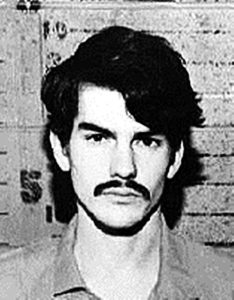
Westley Allan Dodd Case
Recently, an old friend asked if my knowledge of all the murders and other unspeakable criminals (being a sexual predator, serial killer, etc.) had turned me into a cynic about human nature. I can honestly say that more than twenty years of exposure to capital crimes has not made me cynical. Why? Because decent, ordinary folks vastly outnumber the people who commit crimes.
When I started the Crime Library in January 1998, I made a list of every major criminal case I could think of and came up with eighty-six names, most historical. None involved characters I thought could generate a lot of emotion, mine or the readers. For example, while writing the online biography of Al Capone, I began to appreciate the enormous complexity of his personality. Most people don’t realize that Capone was a capable, reliable bookkeeper for a Baltimore construction firm. That was before his organized crime ties from New York City wooed him away to Chicago, the new Mob frontier.
Early Crime Library
Most of the early Crime Library stories were historical in nature: John Dillinger, Al Capone, Jack the Ripper, and Ted Bundy. Hardened criminals to be sure, but not ones that were in the daily news. They had become words and photos on the pages of many books. When a reader suggested a criminal case, I automatically incorporated it into the website as a subject that we might address in the future. Most of the new names were criminals of whom I had no knowledge whatsoever, like Westley Allen Dodd.
Shortly after posting Dodd’s name on the website, I received a message from a man who wanted to see the Dodd story before I published it. My visceral reaction was anger. Why should I let anyone see our stories before I publish them? Upon reflection, I assumed that this man was Dodd’s attorney hoping to sanitize information on his client before he filed an appeal. I asked him what role he played in Dodd’s alleged crimes?
Response from Victim’s Father
His next message explained that Dodd had stalked, raped, tortured, and murdered his three-year-old son and had photographed the child’s body. I was devastated thinking about the suffering the little boy endured and the pain his family had experienced. This murderer had documented every detail of his ghastly crimes in his diary and had built a torture rack for his next victim.
Dodd became a sex offender in his early teens. Every time he was caught, judges reduced his sentences because he agreed to psychiatric therapy. He conned therapists into believing their treatments were successful so that he could remain free to continue raping children. But molesting little boys was just one step on his way to killing his victims. Murder is one way to avoid having a witness identify you. However, after three killings, Dodd wrote in his diary that he enjoyed murder more than merely molesting a child.
The State of Washington realized from the Dodd case that its programs for violent sexual predators were a tragic failure. Dodd insisted that men like himself were incurable. “I must be executed before I have the opportunity to escape or kill someone else,” he said. “If I do escape, I promise you I will kill again, and I will enjoy every minute of it.” After much handwringing among officials and the public, Washington passed a state law to continue imprisonment of some violent sexual predators after their sentences were served.
What I Learned
This case was the wake-up call for Marilyn J. Bardsley, the recovering Nancy Drew, budding armchair crime historian. Yes, telling John Dillinger’s story can be interesting, and the circumstances of Al Capone’s marriage are entertaining, but the horror of a Westley Allan Dodd shakes you to your core. Immediately, I asked a very sensitive, experienced writer to tell the story of this criminal and his victims and to send it to the father as he had requested. The savagery of Westley Allan Dodd’s crimes will stay with me until I die. Washington State executed Dodd in 1993. An interviewer asked Dodd why he refused all appeals. “World War III is going on inside me…I just want to make the pain go away,” he answered.
In my decade of managing The Crime Library, some cases permanently stained my consciousness. Those cases are probably ones about which most people have little or no knowledge, but I will tell you about them in future blogs and books.
Buckle up, my friends.